
Start your project with us today

Logical Why

Search for what you need, or explore the menu on the left to discover solutions, insights, platforms, and experiences crafted for your journey.

What we build
Ecosystem partners
What we prove
Proven impact
What we think
Who we are
How we work together
Search Results for ""
No matches found for your search.
Cart to Loyal
Retail & consumer Case Study

Cart to Loyal

V
Vivsaroma
April 29, 2026

Project Summary

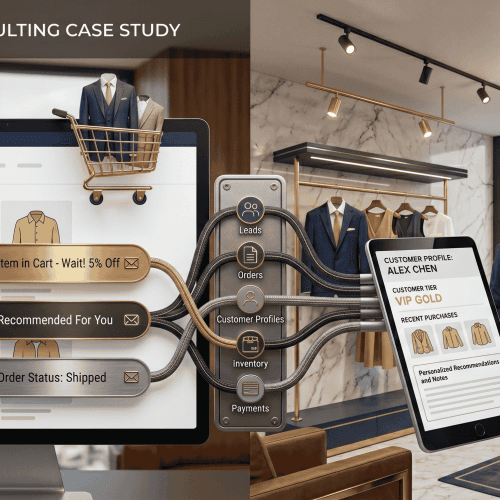
A fashion retailer with strong traffic but weak retention was losing revenue to abandoned carts, disconnected channels, and generic marketing. Logical Why unified their e-commerce, POS, and CRM into one connected system — automating personalized follow-ups, equipping store staff with real-time customer insights, and replacing mass campaigns with behavior-based communication. Within 90 days, cart recovery improved, repeat purchases climbed, and the brand stopped losing customers it had already won.

The Challenge

A growing fashion retail brand operating across both online and offline channels was facing a problem that looked invisible on the surface — but was quietly costing them significant revenue every single month.

Abandoned carts were accumulating with no recovery system in place. Customers would browse, add to cart, and disappear — with zero automated follow-up to bring them back.

The disconnect didn't stop there.

In-store staff had no visibility into what customers had browsed or purchased online. A loyal online buyer could walk into a store and be treated like a complete stranger. The experience felt fragmented — because it was.

Marketing campaigns were going out to the entire customer base with the same message, the same offer, the same tone. No segmentation. No personalization. Predictably, open rates were low and conversions were lower.

The brand had data — plenty of it. But it lived in silos. Their e-commerce platform, point-of-sale system, and CRM were three separate worlds that never spoke to each other. The team knew something was wrong. They just couldn't pinpoint where the revenue was leaking — or how to stop it.

01. The Solution

Logical Why began with a diagnostic of the brand's entire customer journey — mapping every touchpoint from first website visit to in-store purchase and beyond.

The first step was unification. The e-commerce platform, POS system, and CRM were integrated into a single, connected ecosystem. For the first time, the brand had one complete view of each customer — their browsing behavior, purchase history, preferences, and last interaction — all in one place.

Next came automation. Intelligent workflows were built to trigger personalized follow-ups the moment a cart was abandoned. Customers received timely, relevant messages via WhatsApp and email — not generic reminders, but communications tailored to what they had actually shown interest in.

In-store experience was also transformed. Sales associates were equipped with real-time customer profiles before approaching a shopper — knowing their online wishlist, past purchases, and size preferences. What used to be a cold interaction became a warm, informed conversation.

Finally, the marketing approach shifted entirely. Customers were segmented based on behavior, purchase frequency, and intent. Campaigns were no longer blasted to everyone — they were delivered to the right person, at the right time, with the right message.

02. The Impact & Results

The impact was visible within the first 90 days.

Cart recovery rates improved dramatically — automated follow-ups were reaching customers within minutes of abandonment, at a time when their intent was still high.

Repeat purchase rates climbed as personalized communication made customers feel seen and valued, not marketed at.

In-store conversion improved as associates, now equipped with customer context, could have meaningful conversations instead of starting from scratch.

Marketing efficiency increased significantly — with segmented campaigns generating higher open rates, better click-throughs, and stronger ROI on every send.

And perhaps most importantly, the brand moved from reactive to proactive. Instead of wondering why customers weren't coming back, they now had the visibility and tools to keep them engaged long before they had a reason to leave.

Healthcare Orchestration
Healthcare
Healthcare Orchestration

Comming soon

Pharma Field Automation
Healthcare
Pharma Field Automation

A pharmaceutical client faced challenges in managing their field force operations, particularly around planning, tracking, and reporting the activities of medical representatives (MRs). The lack of structured systems resulted in limited visibility, inefficient expense tracking, and gaps in order management.

Luxury Retail Intelligence
Retail & consumer
Luxury Retail Intelligence

A leading luxury retail brand wanted to modernize how it managed customer relationships, supplier onboarding, and personalized communication across its growing business operations.