
Introduction
Most hospitals today are doing everything they can to improve patient care — hiring better staff, investing in infrastructure, and adopting new technologies. Yet despite all these efforts, one problem continues to exist silently:
Patients still feel disconnected.
They struggle to book appointments, wait endlessly for updates, miss follow-ups, and often feel like just another entry in the system rather than someone who truly matters. While hospitals may not always recognize this as a major issue, it directly affects trust, satisfaction, and long-term patient relationships.
This is where the conversation around mobile apps usually begins — but often in the wrong way.
The Real Problem Isn’t Technology — It’s the Experience
Many hospitals believe building a mobile app is the ultimate solution. On the surface, it sounds reasonable. A mobile app can allow patients to:
- Book appointments
- Access reports
- Communicate with doctors
- Receive notifications
But simply having an app does not guarantee a better patient experience.
In reality, many hospital apps fail to create real engagement. Patients download them once, use them for a single purpose, and never return. The app exists, but it doesn’t truly connect with the patient.
The problem isn’t the lack of features.
The problem is the lack of meaningful interaction.
Where the Patient Journey Breaks
Consider a typical patient experience.
A patient feels unwell and tries to book an appointment. They may need to call the hospital, wait on hold, or navigate a complicated process. Even after successfully booking, they rarely receive timely reminders or updates.
After the consultation:
- Follow-ups depend on the patient’s memory
- Reports are difficult to access
- Communication becomes fragmented
- Support feels inconsistent
Over time, this creates frustration and disengagement.
Hospitals often focus heavily on treatment, but patients remember the overall experience.
Why a Mobile App Becomes Important
A well-designed mobile app can completely improve this journey.
It can:
- Simplify appointment booking
- Reduce waiting time
- Provide easy access to medical records
- Enable faster communication
- Improve convenience for patients
More importantly, it creates a continuous connection between the hospital and the patient.
When used effectively, a mobile app becomes more than just a digital tool — it becomes a bridge between care providers and patients.
Patients can:
- Receive instant appointment confirmations
- Get automated reminders before visits
- Access prescriptions and reports anytime
- Stay connected with doctors and support staff
This convenience builds trust and strengthens patient relationships.
Beyond Features: Creating a Connected Experience
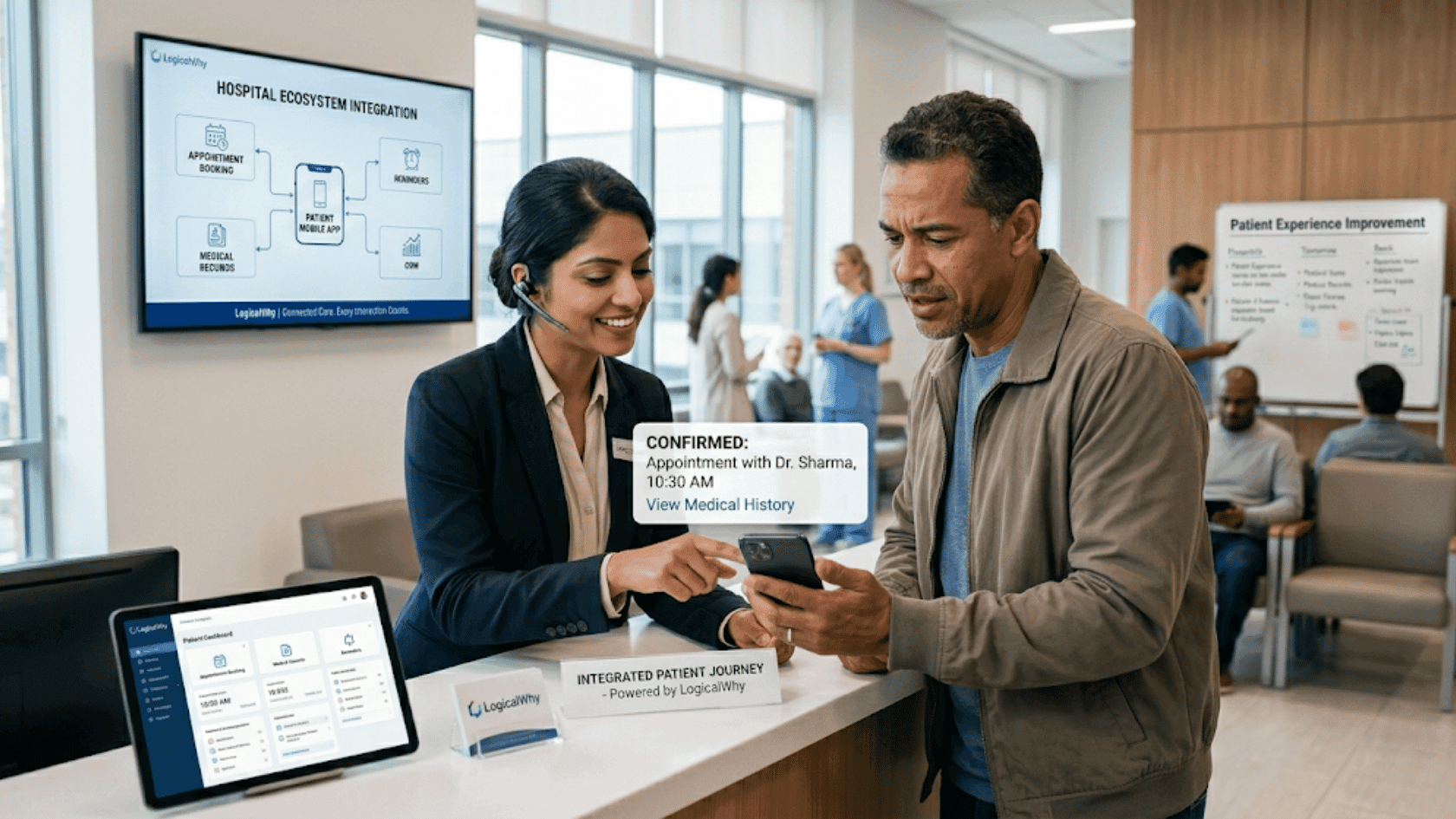
The real impact of a mobile app comes when it is connected to a larger healthcare ecosystem.
An app alone cannot solve every operational challenge. It must integrate with:
- Hospital management systems
- Patient records
- Internal workflows
- Communication channels
- Automation processes
For example:
- When a patient books an appointment, the system should automatically update schedules and notify departments.
- If a patient misses a consultation, follow-up reminders should trigger automatically.
- Reports and prescriptions should become instantly accessible without manual intervention.
This level of coordination creates a seamless patient experience — something still missing in many healthcare systems today.
The Shift Hospitals Need to Make
Hospitals should stop viewing technology as just another feature addition.
The real goal should be improving how patients interact with the hospital at every stage of their journey.
Technology should:
- Reduce friction
- Improve accessibility
- Strengthen communication
- Personalize interactions
- Build long-term trust
Hospitals that understand this shift evolve from being service providers into experience-driven healthcare organizations.
They don’t just treat patients.
They engage with them, support them, and stay connected even beyond the visit.
The LogicalWhy Approach
At LogicalWhy, the goal is not simply to develop mobile applications.
The focus is on building healthcare systems that work effectively in real-world scenarios by:
- Understanding patient behavior
- Identifying communication gaps
- Connecting every touchpoint
- Automating repetitive processes
- Improving operational efficiency
When mobile apps are combined with the right integrations and automation, hospitals can transform both their operations and patient relationships.
Instead of disconnected interactions, patients experience a journey that feels:
- Smooth
- Responsive
- Personalized
- Reliable
Conclusion
Hospitals do not need technology for the sake of technology.
They need solutions that genuinely improve how patients experience care.
A mobile app, when implemented correctly, is not just a digital addition — it is a step toward:
- Better communication
- Stronger patient relationships
- Improved trust
- Higher patient satisfaction
In the end, success is not about adding more features.
It’s about making every patient interaction count.