
Introduction
Modern organizations have never had access to more technology than they do today.
CRMs manage customer data.
Marketing platforms automate communication.
Analytics tools generate reports.
Project management systems organize tasks.
Support platforms track customer issues.
Mobile apps improve accessibility.
On the surface, it looks like businesses are becoming more advanced and efficient.
But internally, many organizations are experiencing the opposite.
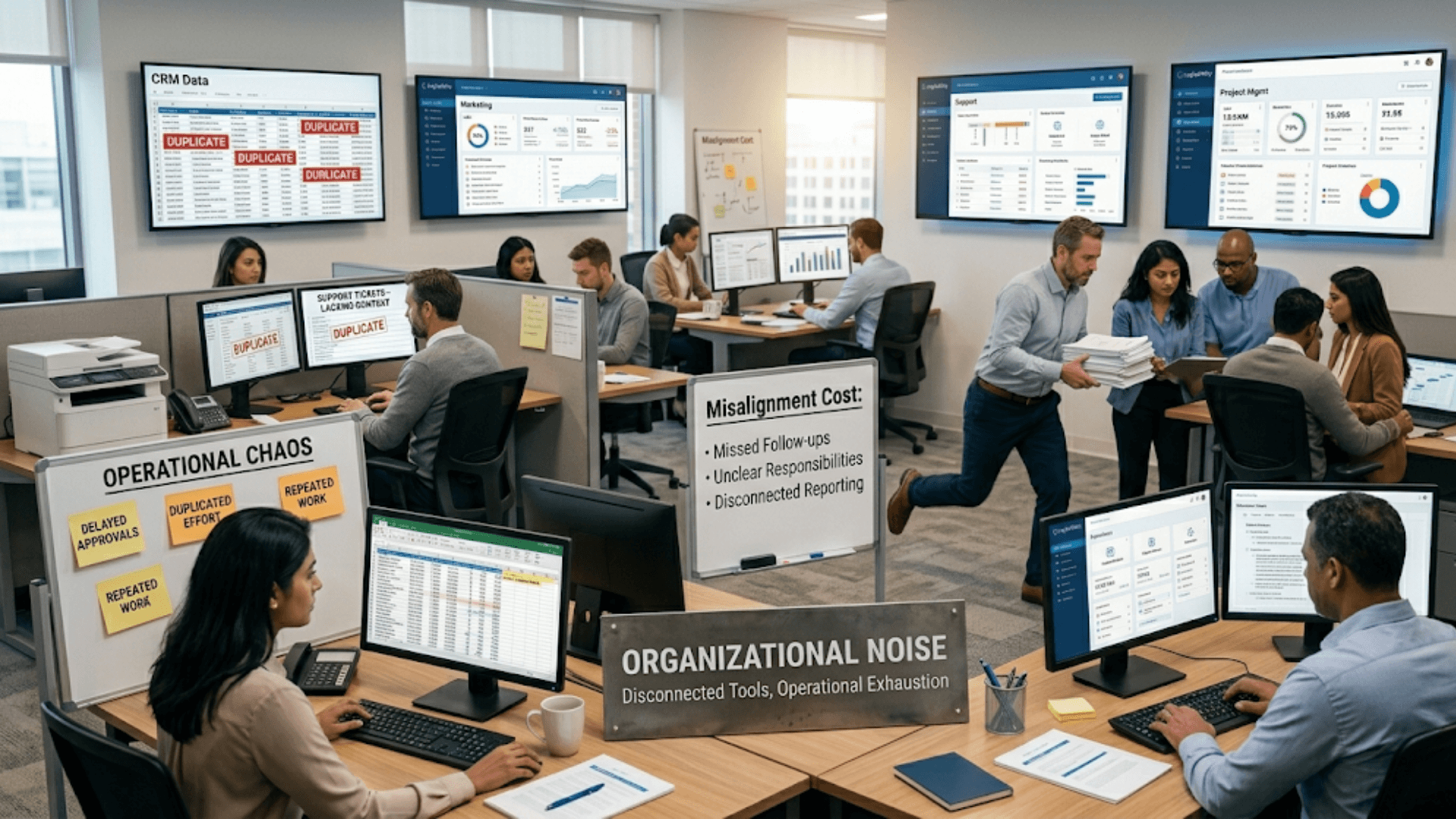
Despite using dozens of platforms, teams still struggle with delays, communication gaps, operational confusion, and disconnected customer experiences.
The problem is not the absence of tools.
The problem is the absence of alignment.
The Growth of Technology Has Created a New Problem
Over the last decade, businesses have adopted technology rapidly.
Every operational challenge now has a software solution:
- productivity tools
- automation systems
- collaboration platforms
- customer engagement software
- analytics dashboards
- workflow management applications
Individually, these systems are powerful.
But most organizations never stop to ask an important question:
“Do these systems actually work together?”
In many cases, the answer is no.
And that is where operational friction begins.
More Tools Don’t Automatically Create Better Operations
There is a common assumption in modern business that adding more technology improves efficiency.
But technology only improves operations when it creates clarity and coordination.
Otherwise, it creates complexity.
Different departments begin operating inside different systems.
Information becomes fragmented.
Processes become dependent on manual communication.
Teams lose visibility into each other’s work.
As a result, organizations become digitally crowded but operationally disconnected.
Everyone is working.
Yet progress still feels slow.
The Hidden Cost of Misalignment
Misalignment rarely appears as one major failure.
Instead, it appears through small everyday inefficiencies:
- repeated work
- delayed approvals
- inconsistent communication
- duplicated data
- missed follow-ups
- unclear responsibilities
- disconnected reporting
Over time, these small inefficiencies create larger organizational problems.
Employees become frustrated.
Leadership loses visibility.
Customers experience inconsistency.
And eventually, the business starts feeling more complicated than it should.
Customers Experience the Disconnect Immediately
Most organizations think internal misalignment only affects employees.
But customers notice it first.
A customer speaks with support, then repeats the same issue to another department.
Marketing sends irrelevant communication.
Sales teams lack updated information.
Service teams respond without context.
To the customer, the organization feels disconnected.
And in today’s digital environment, customers expect businesses to operate seamlessly.
They do not care which department handles what.
They only care about how smooth the experience feels.
Alignment Creates Operational Clarity
The most efficient organizations are not always the ones using the most tools.
They are the ones where systems, teams, and workflows operate together smoothly.
When alignment exists:
- data flows properly
- teams share visibility
- communication becomes faster
- decisions improve
- workflows become simpler
- customer experiences become consistent
This creates operational clarity.
And clarity is one of the most valuable advantages a business can have.
Technology Should Connect Operations, Not Complicate Them
The purpose of technology is not to increase operational noise.
It is to reduce friction.
Good systems simplify collaboration.
They remove unnecessary effort.
They improve visibility.
They help organizations move faster without creating confusion.
But when systems are disconnected, technology begins creating the very problems it was supposed to solve.
Instead of enabling efficiency, it creates dependency on constant coordination between people.
That is not scalability.
That is operational exhaustion.
Why Alignment Is Becoming a Competitive Advantage
In the past, businesses competed through products and pricing.
Today, they increasingly compete through operational experience.
Customers now expect:
- faster responses
- personalized communication
- seamless interactions
- real-time updates
- consistent service
Delivering these experiences requires alignment across the entire organization.
A disconnected business cannot create connected customer experiences.
This is why alignment is no longer just an internal operational concern.
It has become a direct business advantage.
The Shift Organizations Need to Make
Most organizations focus heavily on acquiring new technology.
Very few focus equally on connecting what already exists.
The real transformation begins when businesses stop asking:
“What new software do we need?”
And start asking:
“How well do our systems, teams, and workflows operate together?”
Because growth without alignment eventually creates operational chaos.
Connected operations create sustainable scalability.
The LogicalWhy Perspective
At LogicalWhy, the focus goes beyond implementing tools.
The goal is to create connected ecosystems where systems, communication, automation, and workflows function as one coordinated experience.
This includes:
- intelligent integrations
- centralized visibility
- automated coordination
- connected customer journeys
- streamlined operational processes
Technology should not feel fragmented.
It should feel invisible — quietly enabling smoother operations across the organization.